

Stay in the loop with the latest news and events from the Sustainable Innovation Ecosystem

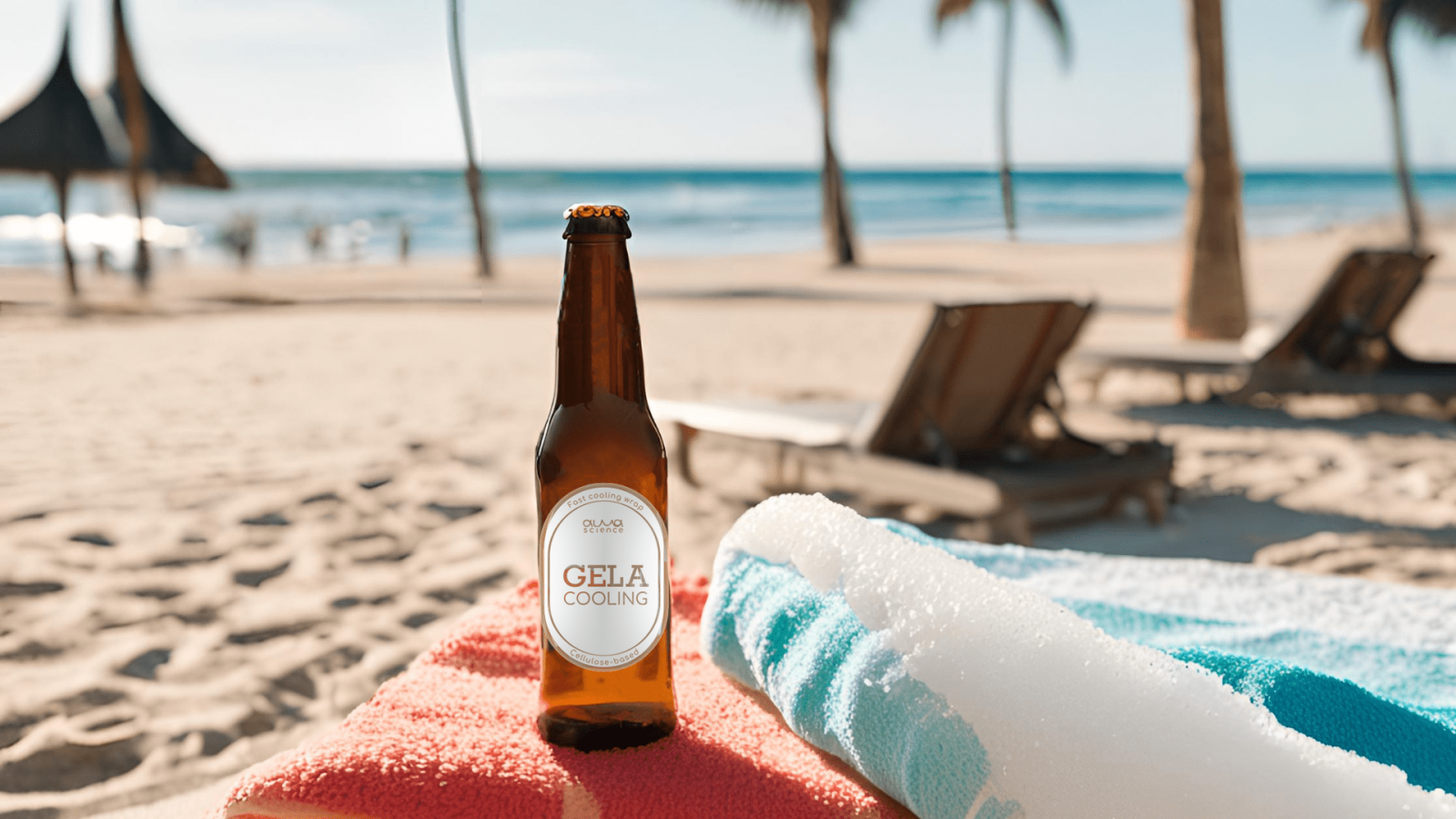
GELA by AlmaScience: a revolution on ice at the shore of Costa da Caparica Beach.
Are your fan-shaped toes full of sand, are you stretching out in a bathing suit on a beach towel somewhere in the world under the same magic star called the sun we all happily share? Eureka! If so, it’s quiz time!
What’s honey gold, white, bitter, blond – and best served chilled? Yes! You’re burning!!!
A beer.
What could be worse than a lukewarm beer when chilling with friends at the beach, in picnics, watching soccer screaming at the screen as if it could feel guilty, or celebrating summertime at the back of the garden around laughs and barbecue embers?
A lukewarm drink, be it a beer, wine, liquor, or soft drink, is not just a gustative crime, it’s a social offense.
The bucket filled with water and ice you see in improvised bars at festivals and parties proves a deceiving device. Who wants to wait for a beer refill to cool endlessly in the middle of a heated sports game or great gossipy conversation, now really?
We needed chivalrous science to come and rescue your hot summer day.
AlmaScience, the Portuguese sustainable innovation R&D CoLab, with expertise in functional natural materials and green electronics, sensibly nested in Lisbon South Bay, between Nova University of Lisbon, and the stunning stretch of Costa da Caparica Beach, host the eco-knights who took upon themselves to change the status quo.
GELA is a sustainable technology and an innovative answer to the cooling process. Made entirely out of sustainable cellulose, it powers cooling acceleration, majestically speeding up the process, so a bottle turns icy cold within minutes with a 100% recyclable and compostable device.
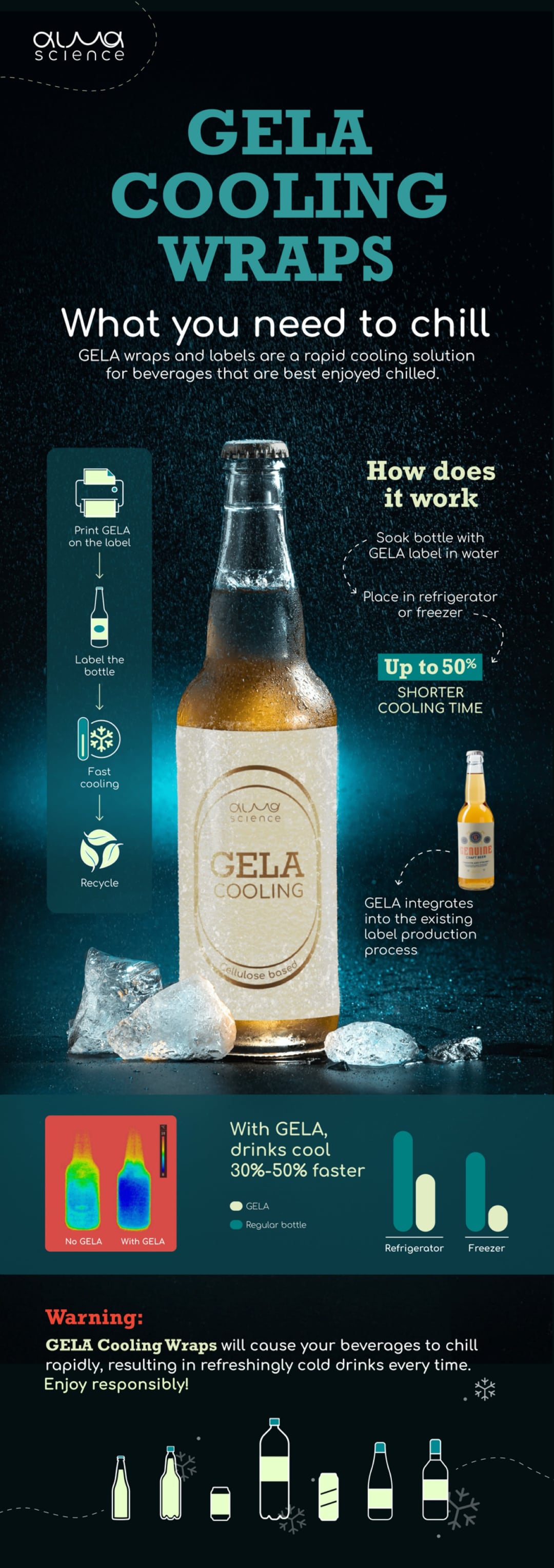
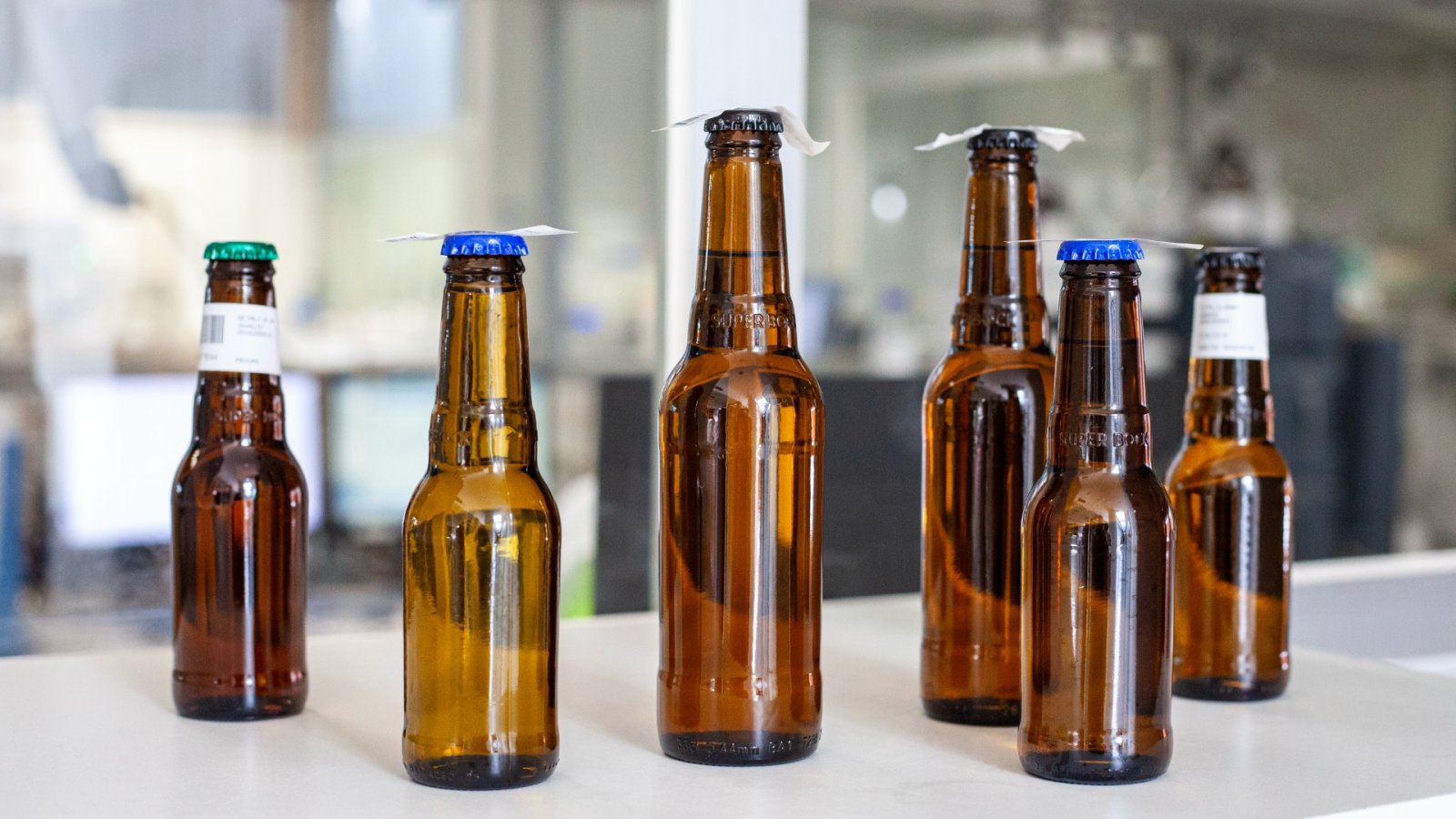
Watch the video below: the bottle looks like any other beer bottle; it just happens to be equipped with a GELA-infused label that works just like a regular label, down to the graphical branding. Take your GELA-equipped bottle, wet it in the sink, place it in the fridge, and wait a bit for the magic trick to happen: within minutes your drink will be ice-fit and suave, with lovely wet drops rolling down, and sparkling sparks designed for instant pleasure.
Eyes half-closed in the zenith hour, you might wonder about the paradox:
Isn’t it quite ironic that beer and most fine drinks are conserved in bottles since glass is such a poor thermal conductor? Wonder why light bulbs, x-ray tubes, and many other electrical products are made from glass? One reason is that glass has excellent thermal insulating ability – but when it comes to cooling, it is counterproductive and a heavy energy eater.
GELA is the superhero technology that reverses glass’s poor thermal properties and gives bottles a cooling boost. It reminds us that, in innovation, simple ideas are often those turning groundbreaking.
Anyone who lived through the punk scene of the late 70s also remembers office life in the 1980s, before and after the cheeky yellow Post-it.
GELA has that kind of swagger.
GELA is the sunny side buddy of a cubo de gelo, which means “ice cube” in Portuguese.
A superpowered and sustainable instant bottle cooler that felt missing for way too long unsurprisingly bursts to life in that hyper-desirable and sunny place on the planet called Portugal.
Portugal is where the right bottle temperature for its selection of beer, “vinho verde” (the legendary green wine outdating rosé), and its large variety of white wines, is taken seriously.
GELA is for people taking their drinks seriously. GELA is for beverage producers that want their products and brands to feel coooooool.
No wonder the capital city Lisbon is where the palpable social shift towards a plethora of new-generation alcohol-free beverages can also be felt on rooftops and sunbathing terraces. Lisbon has become a giant and inventive cocktail open bar with and without alcohol. A city where all tastes and styles transform with one imperative: cool, cold drinks.
You might be among the spectacularly healthy and progressive generation who practices yoga in Estrela Park, runs daily along the Tagus River, or plays paddle in Marvila in an Oysho skirt. In that case, you might also be a GenZ trendsetter, replacing alcohol with kombucha, refreshing lemonade, mocktails, and alcohol-free beers. Mocktails just made the top 10 of Yelp’s 2023 Food Trends, where searches were up 59%.
For all your favorite pick-me-ups to be perfect, cooling drinks faster has become key to a successful birthday party at the back of a restaurant, an open-air kiosk, a beach bar at twilight, or one of the far-stretching 360-degree rooftops gazing over Tagus River. If you are among those changing the drinking trends on the global market, particularly since 2020, GELA will be matching you with its cooling revolution.
It’s no wonder GELA was born on this side of the hemisphere.
It is made of a cellulose-based gel, 100% sustainable and compostable, and it will cool the bottles in half the time when placed in the refrigerator, be it on a portable icebox container in the back of your glamourous camper van or in a fridge at a glamorous beach bar serving the perfect sunset party, which means that GELA saves time, money and energy.
There is no doubt the titans reigning over the beer market will come behind GELA for its simple and quasi-instant effects: a cost-effective, truly environment-friendly way to serve eco-friendly beverages to consumers. In fact, several major wine and beer brands are already looking into integrating GELA technology into their labels for next summer. To this, we say: it can’t come soon enough! Or, as José Almeida, part of a focus group testing the product for the last couple of months, put it, “It’s heavenly to have a chill six-pack in no time for the start of the match.”
The terrific news is that you can be a consumer of any type of beverage, GELA technology will speak to you. Are you among those who love a mineral crisp white wine with seafood, or perhaps before a meal, without having to drown its subtle flavors into rocky ice cubes? GELA will extend its magic cooling embrace around your best wine as well.
Ask Americans about their cult, rather than just a “culture”, of long-lasting love for ice. No restaurant in New York or Los Angeles, not even a dive, will welcome its clients without the custom ice-cold water glass. That’s the land where the high-end refrigerator producing ice cubes has turned into a must-have in a sleek Italian design kitchen.
Who hasn’t stopped with nostalgia in a tired motel, in downtown Las Vegas, and poured a few dollars in the soft drink distributor for that sexy icy cool rock’n’roll drink rolling out with a roaring noise? Often so cold it will mask the high-sugar intake of, say, a Cherry Coke!
What makes the bottle and its content, no matter what it is, so sexily attractive is precisely the promise it carries: to be the coolest drink you will have in the scorching heat of summer!
Before your eyes close for a nap, you might be wondering which eco-conscious brand will first embrace the power of GELA?
We will soon let you know. Something you learn in Portugal is that moving slowly is moving closer to the rhythms of seasons, and steadily towards more sustainable solutions.
This is true in design, products, solutions, slow fashion, and in architecture. And now it is also true of drinks: cool fast, enjoy slowly (and responsibly)!
Share this link wildly with your networks. And for your by-now sunburned friends, here are some cool and silly facts to share with drinks!
The number of beverage consumers in the global market is projected to reach 1.5 billion by 2029. Sustainability is more than ever a key issue for the soft drinks industry. Innovations in packaging, efficiencies in transport, and savings in energy and water use in the production of soft drinks contribute to reducing our environmental impact.
RecycleNow will guide you through your recycling duties. Current recycling rates are rising, but there is still room for improvement:
"Chilled wine was all the rage in first-century Rome. Ice chunks were brought down from the summits of Mount Vesuvius and Etna to chill the food and drinks of the wealthy. Roman author Pliny the Younger ascribes to Emperor Nero both the invention of the ice bucket and the chilling of water." The fabulous History of Chilled Drinks, on how “The innovative ‘frozen water’ trade popularized ice”, by Tulasi Srinivas at Emerson College, is a throve of great storytelling.
The term soft drink was originated to distinguish flavored drinks from hard liquor, or distilled spirits. Soft drinks were recommended as a substitute to change the hard-drinking habits of early Americans. The first marketed soft drinks appeared in the 17th century as a mixture of water and lemon juice sweetened with honey. In 1676, the Compagnie de Limonadiers was formed in Paris and granted a monopoly for the sale of its products. In America, vendors carried tanks on their backs from which they dispensed cups of lemonade.
By about 1820, improvements in manufacturing processes allowed a much greater output and bottled water became popular. Mineral salts and flavors were added: ginger in about 1820, lemon in the 1830s, and tonic in 1858. In 1886 John Pemberton, a pharmacist in Atlanta, Georgia, invented Coca-Cola, the first cola drink.
Today, all around the globe, soft drinks have captured 45% of the total beverage market. The global health and wellness beverage market is expected to grow at 6.1% annually from 2020 to 2027. Gen X and Millennials contribute the most to lower-alcohol and no-alcohol products. Each generation represents 54% and 41%, respectively. They adopt healthier lifestyles, exercise more, and spend more money, dining outside. Source: Beverages Statistics 2024.
Progressive brands ally great packaging and eco-friendly production to the new generation of non-alcoholic drinks. Take ISH, a Copenhagen-based producer of nonalcoholic wines, spirits, and cocktails, which is now distributed in all US 50 states through ZeroProof. On the same platform, Optimist Drinks, a collection of Los Angeles-inspired distilled botanical spirits made without alcohol, has joined the market in 2021. Zero Proof is a Black-LGBTQ+-owned business launched in January 2022, which includes zero-proof gin, bourbon, and tequila. Source: Beverage Dynamics.
The market of soft drinks and bottled beers is a key driver of the convenience business because of its sheer size. In soft drinks alone, it’s worth £2.4bn in sales every year, and it enjoys a boom during the summer. A spell of high temperatures has an immediate impact on sales as people shop for refreshing drinks to consume immediately and cool down. AG Barr points out that from June to August, shoppers purchase 36% more soft drinks than at any other time of year, with water, fruit drinks, and other flavored carbonates seeing the biggest sales uplifts. Source: Talkingretail.com.
Beverages Statistics 2024 reports that functional beverages, including energy and sports drinks, are currently the fastest-growing segment in the beverage market. Some calory figures:
Source: Coolest Gadgets.
The figures fit the visible increase of runners across Western capital cities. It also matches the latest fashion trends. The global sports-inspired clothing market is forecast to expand at a CAGR of 5.3% and thereby increase from a value of US$ 315.03b in 2023, to US$ 452.2b by the end of 2030 as per the report published by Persistence Market Research.
Americans love ice. Water, Cokes, cocktails, and coffee are poured into ice with the greatest generosity. Haley Chouinard writes in No Chill: A Closer Look at America’s Obsession with Ice, “A cold beverage is not a luxury in America — it’s an expectation”. According to kitchen design sellers, “The ice maker is the appliance my clients care the most about”, says one of them.
In The Science Behind Our Love for Cold Drinks: Exploring the Chilling Pleasure, ghostwriter Abbasthecreator writes, “Our bodies naturally crave hydration, and a cold beverage provides not only fluid replenishment but also a sensory reward. The coolness and refreshing taste of a cold drink amplify the feeling of quenching our thirst, making the experience more satisfying than drinking room temperature or warm liquids”.
In the USA, beer is the most preferred alcoholic beverage. Overall, beer is the most popular alcoholic beverage in the world in terms of volume consumed. But its main ingredient, barley, is in sharp decline in periods of extreme drought and heat, according to Nature.
Meanwhile, barley can also be used for packaging. AB InBev brand Corona was the first global beverage brand to roll out six-pack cartons made using barley straws. A Queen's University Belfast researcher has developed a low-cost technique to convert leftover barley from alcohol breweries into carbon, which could be used as a renewable fuel for homes in winter, charcoal for summer barbecues, or water filters in developing countries.
Breweries in the EU throw out around 3.4 million tons of unspent grain every year, weighing the equivalent of 500,000 elephants. Using just 1 Kg of the grain, Dr Ahmed Osman from the School of Chemistry and Chemical Engineering has been able to create enough activated carbon to spread across 100 football pitches. Source: Science-Daily.
In Europe, the top 5 countries leading ‘beer consumption per capita’ in 2022 (in liters) are:
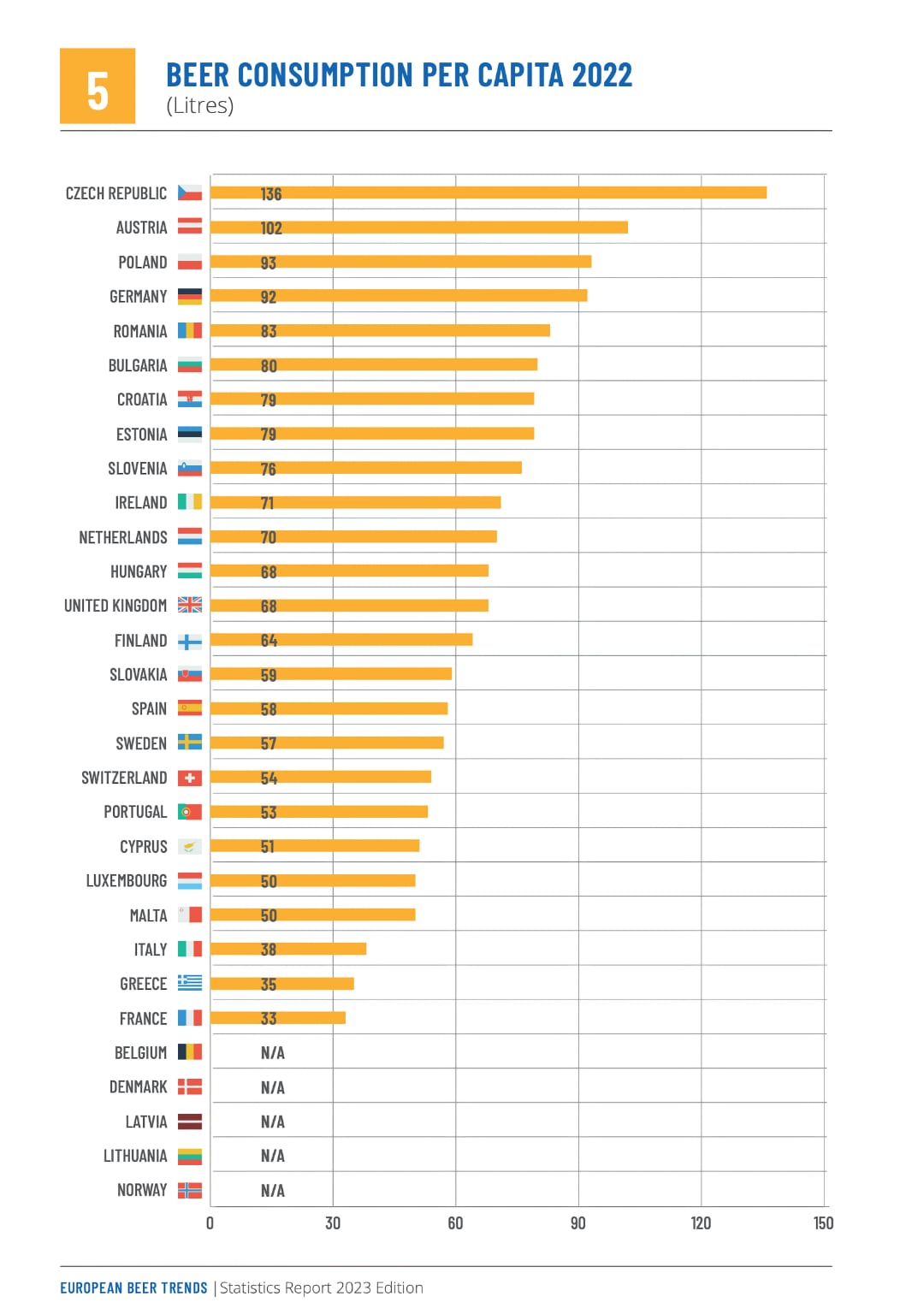
The three countries in Europe with more than 1,500 active breweries in 2022 are France, Germany, and the U.K. Source: Brewersofeurope.eu.
In Europe, during the 2024 European Championship, the most expensive price for beer was to be found in Northern countries, including the U.K. and France. Reykjavik in Iceland tops the list at €10 per beer, closely followed by Oslo in Sweden, at €9.6 per beer. The cheapest? Kyiv in Ukraine at €1.1. Lisbon, Portugal, is fairly priced at €3. Source: Euronews.
Chew on these weirdo highly experimental beers: "From dung-smoked whale testicles — stay with us — to chocolate oyster stouts, experimental beers are having a moment." It might be a marketing moment, but writers Alex Delany and Josh Ocampo try a few out. Here is the complete article made for good beach laughs: bonappetit.com.
You might be swatting flies away from your pint or bottle and wondering why. According to scientists at the Flanders Institute for Biotechnology and the University of Leuven, yeast cells produce aromas that are highly attractive to flies. This is an evolutionary trick for yeast. The attraction allows some yeast cells to latch onto the insects and be taxied to fresh food sources — a vital survival process for the otherwise immobile cells to prosper.
The exact same yeasty aromas make beer and wine taste good to humans, to a degree which “has long been underestimated”, says Dr. Kevin Verstrepen. Source: BBC Science Focus.
Finally, to resist the high temperatures, here is a great guide on how to reduce human body temperature and cool down in the high season. “Immersing your hands in cold water won’t feel as nice, but it’ll cool you much faster than even an ice bath! It’s so important to make a distinction between things that make you feel cooler and things that actually make you cooler.” Source: BBC Science Focus.
This work is supported by the Recovery and Resilience Plan (RRP) and by the Next Generation EU European Funds through the Green Agenda for Business Innovation “FF2F - From Fossil to Forest” (Project nº 8), a consortium led by The Navigator Company, in which AlmaScience collaborates with RAIZ and the Super Bock Group.

AlmaScience is a collaborative innovation R&D lab and a technology incubator for sustainable functional materials and green electronics.

Stay in the loop with the latest news and events from the Sustainable Innovation Ecosystem